Wednesday, April 13, 2011

(Short story) A WINDOW IN THE WALL By Dr. Shahzad A. Rizvi

Since I’d rented the room, I’d often wondered about the window. Why was it built? Who built it? On one side, it opened into my room. And on the other, I was sure that it opened into some interior part of the mansion next door. For some unknown reason, it was built into the common wall and did not perform any of the usual functions of a window by providing light, air, or an outside view.

It didn’t take me long to settle down in my little room. It was no more than six by eight, I was sure. I set up the shaky desk and a chair in one corner, and unrolled the bed on the floor in the other. There was no closet, so I left the few clothes I had, underwear, socks, and a few knick-knacks in the jute sack that I’d brought them in, deciding to use it as my pillow, as well. When I brought in my rickety bike, the room was crowded, but my move was complete. During the night, after I turned out the light, I’d hear someone walking around the room. But I chalked it up to my imagination and didn’t think much of it.

Soon, I fell into a routine. I’d get up in the morning, and head out toward the state Department of Education, where I worked as the Special Assistant to the Director who was responsible for all the schools in the state. During the interview, he told me, “You strike me as a very smart young man and you’re exactly what I’m looking for to fill this position. But this will be a very demanding job, requiring a fair amount of travel. If you work out, I’ll make you permanent.”

So I worked extra hard to prove myself, but I had much to learn. And then there was my school. I’d been accepted into the graduate program in English Literature; I’d enrolled at the university and my classes met in the evening. At the end of the day, I’d be so tired that I’d plop down on the bed and fall asleep, but not without thinking about the window.

One day, I came home directly after work. The college break was just starting and I had no evening classes. As I passed the house next door, my feet stopped and I stood staring at the door for several minutes. I set the bike against the wall, screwed up my courage and reached for the knocker with a palpitating heart. I knocked once, twice, thrice—dirt getting all over my hands—but there was no answer. I knocked vigorously; the knocker came off the rotten wood and fell on the stone with a clank, sending spiders and lizards scurrying off. I heard voices behind me. I turned around and looked; a group of people had gathered behind me, with expressions of horror on their faces. I was looking for no one in particular. There was no reason I could offer for knocking at the door. I picked up the bike and dashed off, the expressions on their faces frozen in my memory.

That night I fell asleep, thinking about my experience at the house and wondering about the window. I don’t know how long I had been asleep when something woke me up. When I gathered my wits, I realized that there was a knock. I fumbled in the dark, trying to turn on the lamp, and knocked it down. I walked toward the door and asked, “Who is it?” But there was no answer. I could hear the wind howling outside. Maybe it had been flapping the door? I thought. I opened the door, but there was no one. The knock continued and was becoming louder. Now, I realized it was at the window. My heart began to pound and I was breathing fast.

I turned around and managed to turn on the lamp. It took me a few seconds to adjust to the light; I rushed and unlatched the window. It slowly opened, with a creaky sound. The most beautiful woman I had ever seen was standing on the other side. She had large, dreamy eyes that didn’t seem to focus on anything. Her face was partially covered with tresses of black hair. She was wearing a black sari, tightly wrapped all around her, merging her body into the dark background. The light from my lamp, the only source of light, highlighted her face, making her look like an apparition suspended in the air. My eyes were riveted on her face and no words came from my mouth. Faintly, I could hear music and the words of a song—he will come, he will come—of an old Indian film, coming from her side. I’m not sure how long I stood there.

“May I come in?” she asked in a deep melodious voice.

As if jolted from a trance, I answered, “Yes, yes, of course,” and stepped aside.

Lifted by some invisible force, she glided into the room. My hand pointed toward the chair, but she descended onto the bed. She couldn’t have been more than 22 or 23, my own age, but I felt awe in her presence. She didn’t introduce herself, asked no questions, and didn’t look around. Her eyes remained fixed in one direction. My heart pounded harder, I was breathing faster and a million questions were rising in my mind, but the words were getting tangled up somewhere in my throat.

I heard thunder outside and felt a strong gust of wind. The window shut with a loud bang. The light blinked a few times and then went out. Heavy rain had begun to come down.

“May I spend the night here?”

“What would your people say?”

“There is no one…absolutely no one left!”

“Where’ve they gone?”

“They’ve gone far, far away!”

“When will they return?”

“Do you always interrogate your guests?”

“I’m so sorry. Where are my manners? Of course, you can spend the night here. But there is only one bed.”

“I don’t mind.”

Before I could organize my thoughts around the logistics, she lay down across the bed. As I maneuvered in the dark to find an empty space, her arms reached out and pulled me toward her with great force. Before I could rearrange my body, she planted her lips on mine, sending sensations down my spine that I had never known before. “I don’t have the foggiest idea…” I began, but she put her hand over my mouth and my words came out garbled. She gently guided me and I became immersed in an ecstasy that I had never experienced before. Just as I thought that I had reached the greatest height, she would start me all over again and take me to a level higher than before. This went on until the crowing of a rooster was heard. She jumped up and was in the middle of sailing through the window when I called after her, “Will I see you again?”

“Yes, but don’t try to find me,” she said, her voice echoing as if in a tunnel. The window shut after her and would not open.

For a long time, I sat on the bed thinking about her. Who is she? Where did she come from? She had given me such a transcendent experience, but I knew nothing about her. Will I ever see her again? Tears welled up in my eyes. I had only met her a few hours ago and she had only been gone a few minutes, but I was already missing her. Can it be possible, oh my God, that I have fallen in love with her?

There was a knock and, for a moment, I felt a surge of joy thinking that she had come back. But it soon died down. The knock was at the door. Who could be calling at such an ungodly hour? I got up, feeling as if my body weight had multiplied many-fold. Opening the door a crack, I asked, “Who is it?”

“Babuji, this is Manmohan, the peon. Sahib is waiting downstairs in the jeep. He wants you to come downstairs right away to go on a trip.”

I was yanked as if by an electric jolt into the realities of my life. It was not that my boss hadn’t warned me about the travel, but I hadn’t foreseen that it would be happening at such ridiculously short notice. My inner voice of protest was interrupted by repeated horn honks from downstairs. “Tell Sahib that I’ll be right down,” I shouted to the peon. I threw on some clothes, stuffed another outfit into the jute bag and was out of the door in two minutes.

When I saw my boss, instead of responding to my greeting, he said curtly, “A teacher has been murdered.” His face looked somber, so I didn’t ask any questions, though I was very curious. Quietly, I climbed in the back, and the jeep took off at high speed, sending early morning street sweepers scurrying.

The peon, who was sitting next to me, whispered into my ear: “Sahib hasn’t slept all night. The news of the murder came in the middle of the night. A teacher has killed his wife and another teacher because he found them in bed.” I now understood the urgency of our trip. I also recalled a confidential report of the Principal, forwarded to our office, in which he had expressed concern about this romance.

It was a complicated case, involving our department, the judiciary and the police, and we were gone for several days. But every day, I thought of the mystery woman and eagerly awaited my return so I could see her again.

The case was to go on for months, if not years, but we left. When we arrived back in our town, my boss dropped me off by my building. The first thing I noticed was the absence of the mansion next door. In its place lay a huge pile of rubble. Breathless, I ran after people, grabbing them by the arm and asking them what had happened to the house. They freed their arms, gave me strange looks, and hurried away from me. Finally, I stood desolate, on the verge of tears, when a man with a kindly face tapped my shoulder and pointed toward an old man who was sitting in a little café, sipping tea from a saucer. “That gentleman can answer all the questions about the house,” he said. He cast a look with a strange expression in the direction of the rubble and padded away.

In my comings and goings, I had often seen this old man sitting in the café. Does he have a home…does he have family? I often wondered. When I walked up to him and greeted him with a bow, he pointed toward a chair and gestured for a boy to bring me tea. His brows furrowed, he peered at me through his wire-rimmed glasses and said, “You live in that building. I’ve not seen you for the last eight days.”

The remark surprised me. “I was on an official trip, sir.”

“Hmmm.”

“What happened to the house, sir?”

“Somehow, I had a feeling that you would ask me about it.”

In response, I just bowed my head and heard him order the café-boy to bring a hookah. There was awkward silence. People all around us had stopped sipping their teas and stopped puffing on their bidis—Indian cigarettes—and were intently staring at us. It was making me nervous. Finally, the boy brought the hookah and carefully put it down. He presented its mouthpiece to the old man. Without acknowledging the boy, the old man began to smoke, staring into space, seemingly at things far, far away. Then he addressed me. It took me a few seconds to realize what he’d asked. “Why did you rent that room?”

“I needed a room, sir. And as a student, I couldn’t afford anything better.”

“Didn’t anybody tell you that a murder took place in that room and the room is haunted?”

“Oh my God, no! When did it happen…who was murdered?”

“It’s a long story,” he said. He signaled the boy to bring more tea and asked me if I also wanted some, but I declined. I was eager to hear the story and the suspense was dreadful. Please get on with it, I said saying under my breath. At last the tea arrived and, alternating between puffs on the hookah and sips of tea, he began.

“Twenty-five years ago, a very rich man lived in that house,” he said, pointing toward the rubble. He had a son, the only child. He was born with facial birth defects. He was so ugly that you couldn’t look at him. Kids would harass him and make fun of him, so he had to be accompanied by a bodyguard all the time. When he came of age, his parents began to think of his marriage. According to our custom, proposals are sent by the parents of girls who are eager to see their daughters married off. But in spite of his enormous wealth and social position, no proposals were arriving for this young man. So, after a long wait, the boy’s father, the Seth—as he was called by everyone—asked me if I would look for an appropriate girl for his son.”

“Why did he ask you, sir?” I interrupted.

“Because I worked for him. I was his munim…his chief accountant. Actually, much more than that. I was his factotum; took care of every imaginable thing for him. That’s why he relied on me and trusted me. Anyway, he wanted me to look for a girl and he didn’t care if she was poor…so long as she was of the right caste and was very beautiful. I thought it was strange of my boss to want a beautiful wife for his son, while he was so ugly that he could frighten people in broad daylight. Anyway, for a while, it became a full time job and obsession for me. I had my boss’s confidence that I could do anything and I didn’t want to fail him in this very important task. I neglected the accounts, neglected other duties, but looked for a girl, not any girl but a very beautiful girl. I ate very little, slept very little, traveled far and wide, and approached many families. But they all turned me down. Apparently, my boss’s son’s fame had reached all four corners of the earth.” He stopped talking and leaned toward me. I nodded encouragingly, and he continued.

“Then it occurred to me that the answer had been right under my nose all the time, while I had been looking everywhere. My friend’s daughter in the village where I grew up was the perfect solution. She was beautiful, she was the right age, and she was of the same caste as my boss. My friend was very poor and wouldn’t be able to offer any dowry; but it didn’t matter. My boss had made it very clear that dowry wouldn’t be an issue.

“So I got on a horse and headed for the village. It wasn’t far off. When I got to the outskirts of the village, I found the girl drawing water from the well. Other girls were singing, but she was quiet. When she saw me, she put her pot down and came running and touched my feet. After giving her my blessings, I asked her where her father was. She said he was at the village square, where they were having a panchayat—a meeting of village elders. So, I spurred my horse and arrived where the panchayat was meeting. I was surprised to see that my friend was before the panchs—the village elders—who were deciding his fate. He was heavily in debt and had defaulted on his payments. They were deliberating whether or not to take away his meager possessions.

“My arrival interrupted the meeting. All the panchs knew me; I’d grown up with them. Cutting through their effusive greetings, I immediately came to the point and told them that I had an offer for my friend which, if he accepted, would end all his troubles. I paused, and they all eagerly stared at me—especially my friend, whose fate was in the balance. Addressing him directly, I said, ‘I have brought a proposal of marriage from my boss’s son for the hand of your daughter. Will you accept?’

“As if hit by lightning, the entire assembly was struck dumb. For several seconds, no one spoke or moved. Then they all started speaking at once—except my friend. I had to shake him just to get a word out of him. ‘Yes,’ he said and became quiet again, while everybody congratulated him on his good fortune. My boss was well known in these parts. He was the largest landowner. Needless to say, the panchayat was dismissed on my assurance that I would see to it that all of my friend’s debts were paid off. When I told my friend that he wouldn’t need to provide a dowry or spend a single rupee on the wedding, his sadness went away. He said that he didn’t care what the boy looked like, so long as his daughter had all the comforts of life that he couldn’t give her.

“He took me home. His wife was making kandes—cow-dung patties—to be used as fuel. When she saw me, she pulled the edge of her sari across her face. She quickly washed her hands, brought me a glass of water, and put a bucket of water before my horse. We went inside the one-room thatched-roof adobe house, where my friend’s old mother was lying sick. I touched her feet, as I had always done since I was a child, and she gave me her blessings. I told her that I would arrange for her to see a specialist in the city. We broke the news of the marriage proposal to the ladies and they were delighted. They wanted to sweeten my mouth, but there were no sweets in the little hut. So his wife went to the neighbor, borrowed some tea and sugar, made tea and offered it to me in a chipped clay mug. His wife and mother couldn’t believe this turnaround of their fortune—that now they would be in-laws of the area’s richest landowner. Their days of poverty and misery would be over.

“As we were celebrating, I told them that since they would be his in-laws, my boss was prepared to build them a house, and give them enough land and cattle so that they could live well. The young girl, the centerpiece of all of this conversation, returned from the well carrying a stack of clay pitchers on her head. Her father announced to her what he’d decided. The young woman’s eyes widened in horror, the pitchers crashed to the floor, showering us with shards, and she ran out of the house, screaming as if someone had died. Her father pulled a burning stick from the clay stove and ran after her, shouting, ‘I’ll teach you a lesson for this bad behavior!’ I ran after them and caught the raised stick mid-air before he beat her to death.”

At this point I interrupted the munim, though I was engrossed in the story. “Shouldn’t the girl have had some say in the matter?”

“That’s the thinking of you modern, college-educated, city people,” he said, poking my chest with his finger. “In the villages, they still do things the way they’ve done them for thousands of years. Marriages are still arranged; parents and elders decide where and with whom the children, and I do mean children, will be married; and that’s the end of that. The elders know best. Any objections, any protests, by the boys and girls to be married are regarded as great insults to the elders.”

“Alas, I know that, sir,” I said, nodding. In this day and age, I thought, how can we have these two cultures operating side by side in India?

Oblivious to my inner protest, the munim went on, “I sent my friend back to the hut and sat down with the girl in the midst of a mango grove. Mynahs were singing, peacocks were dancing, and mangoes were falling…and all this had a calming effect on her. I said to her, ‘You’ve known me since you were a child. You would be crying and I would hold you and you would calm down. You’ve always come to me for advice and have listened to me more to than your own father. So no secrets from me. Tell me what troubles you so?’

“She wiped her tears with the edge of her sari and said, ‘Uncle, I love another.’

“Does anybody know about it?’ I asked.

“No uncle, we’ve kept it a secret. He lives in the nearby village. We met at a village fair. He’s handsome and nice but very poor, like us. We meet when I go to draw water from the well outside the village. All the wells inside the village are dry now.’

“I said, ‘Your father is heavily in debt, your grandmother is sick and your mother is exhausted by working day and night with no rest and no good food. You could save them all by marrying my boss’s son. I realize that he’s ugly, but in time you’ll come to like him—even love him—and forget about the boy you love. I strongly urge you to do this. This will be the right thing to do, and the only right thing. This will change your life and the life of your family once for all. You will experience things you never knew existed. If you say yes now, I promise you that I’ll see to it that you’re treated right in that household. If there is any mistreatment, any abuse, I promise you that I will do everything in my power to change it.’ The girl began to cry again and cried for a long time, as I waited for her answer. Finally, she spoke through her sobs, her words almost incomprehensible.

“Uncle, I’ll do it, though it breaks my heart just saying it. I’ll do it to save my family,’ she said and began to cry again. I couldn’t bear to look at her.

“Needless to say, my boss was delighted when I gave him the news of my find. He gave me an immediate raise and a hefty bonus. ‘No time should be lost,’ he said and barked orders to everyone concerned to get busy preparing for the wedding. ‘Money is no object. We’re talking about my one and only son, you know,’ he emphasized. I undertook to rent the elephants for the bridegroom’s procession.

“When the wedding party—seated on golden howdahs on top of ten elephants, bedecked with wreaths and finery, and a hundred-piece band playing in front—arrived in the little village, the villagers were overwhelmed. They were all invited, so they all came deferentially. Wide-eyed men wore their best turbans and women wore their best saris, sitting down under the shamiana, a monumental tent which was set up for the wedding. When the ceremony began, the bride cried inconsolably. People assumed that she was sorry to leave her home; little did they know her real reasons. After the ceremony, a vegetarian dinner was served on palm leaves, which people ate and ate, sitting down on the floor, their legs folded in lotus position. During the dinner, I accidentally spilled a little water on the groom. He slapped me and ranted and raved for quite a while. His outburst marred the occasion, but I tried to salvage the situation somehow. I felt humiliated in front of all the village people I had grown up with, but I tried to put the best face on the situation. Finally, we collected the bride and returned to the city.

“On the wedding night, I was posted outside the room, just in case. I began to hear sounds of a struggle, followed by sounds of beating. The door opened and the girl came out screaming and found refuge in my arms. ‘Uncle, he’s going to kill me!’ The boy stood behind her, with a gun trained on her. ‘I want my conjugal rights. She can’t refuse me,’ he barked. His speech was slurred, his eyes were red, and he looked uglier than ever.

“Of course she can’t, but let me first get you a drink,’ I said, which quieted him. I whispered to the girl that I had something in my pocket and asked her to slip a little bit into his drink every day. The boy gulped the drink down and was soon sound asleep.”

“The boy didn’t get up the next day, or any other day. The best hakims, veds and doctors couldn’t find out what mystery disease he suffered from. Finally, one night, he died in his sleep. His parents and all his relatives held the girl responsible for his death. She was a bad omen…a witch, who had caused his death. According to the custom, as a widow she had to cut her hair short, wear simple clothes with no jewelry, and live with her in-laws. She couldn’t go anywhere or participate in anything. And she couldn’t remarry. From dawn to late into the night, she worked and worked, almost like a slave in her in-laws’ house, and was mistreated to boot. It was a miserable existence. I felt guilty and responsible for getting her into this situation. And I finally decided to do something about it.”

He had barely finished his sentence when the owner of the café came over. “Do you require anything more, sahibs? I’m sorry, but the café is closing; I need to go home.” We apologized and moved to a bench in the nearby park, where the elderly gentleman continued his story.

“Anyway, I brought the boy over, the boy the girl loved, and set him up in the room where you’re now living. There was only a wall between that room and the room where the girl spent her nights crying. As a young man, I had worked with a builder, so I knew all about masonry work, carpentry and plastering. When my boss and his wife were away, I punched a hole into the wall and built a window as a passageway between the two rooms. In the girl’s room, the window remained covered up by a huge almirah, so if anybody walked in, he or she wouldn’t notice it. Besides, no one bothered to go in her room anyway. Now the girl was very happy. She could visit the boy in the little room when everyone was asleep.

“All of a sudden, my father passed away and my mother was very ill. I had to go to my village and was gone for a long time. During my absence, my boss found out what was going on. He hired a hit man to kill the boy. The murder was to take place while my boss and his wife were conveniently away on a pilgrimage.

“Instead of drowning the boy, as the boss had suggested, or killing him in an alley or some such place, the hit man butchered him right in his little room, splattering his blood all over the place. Unable to bear the pain, the girl found a gun in the house and blew her brains out. As if that was not enough, my boss and his wife were in a train-wreck while returning home and were killed. I suppose there was some kind of justice in it.

“When I finally returned after the funeral of both of my parents, the police were investigating the matter. They did catch the hit man; he was tried and sentenced to life in prison. The next-of-kin tried to occupy the house, but they were scared out of there. They claimed that they saw the girl walking around the house, carrying a lamp in the middle of the night. Things would happen to them, without any explanation.

“All these deaths drove me into a deep depression. I felt responsible. All the deaths that took place there”—he pointed to the demolished house and the building I lived in—“I feel responsible for them. I should’ve known better than to force a beautiful young woman to marry an ugly, tyrannical ogre. That started the chain of deaths. I will never forgive myself. I’ve walked around for 30 years carrying that pain in my heart and I’ll carry it to my grave.”

He stopped talking. I was certain that he had tears in his eyes, but in the dark I couldn’t see them. I very much wanted to tell him about my experience, but I couldn’t bring myself to do it. I thanked him for taking the time to tell me his story. I hoped to see him again and try to lessen his pain. Somehow, we are bound together, I thought, and the beautiful woman who lived many years ago is the link between us. I passed by the rubble of the house and visualized her soul now buried there. Then I looked up to the window. The moon had come out from the cloud cover and its light was falling on the window. I’ll never see her again, I thought, and tears rolled down my cheeks.

I went up to my room and turned on the light. I had a feeling that I was not alone. But things were just as I had left them. I sat on the bed and thought of the two lovers who used to meet in this room. Then I thought of my own feelings. They were now all jumbled up. Maybe I dreamed up what happened to me that night? It seemed so long ago…and so unreal now. I was feeling strange sensations all over my body. I couldn’t settle down, nor did I feel like studying. I got up and unlatched the window. Its door swung open and a gust of wind swept in, stirring things inside the room. There was nobody behind it.

The rubble of the house lay still down below. Some dark shadows were scavenging in it. In the distance the whistle of the night policeman and his call “Stay alert!” could be heard. I closed the window and lay down. A lot had happened in the last few days. Fatigue and sleep came over me.

I don’t know how long I had been asleep when a knock woke me up. I got up with a start and listened. It was gentle and persistent. It was clear that it was not coming from the door. But it can’t be coming from the…but it was. I got up and unlatched the window. It swung open and there she was, standing there in all her glorious beauty. “Aren’t you going to invite me in?”

Tuesday, April 12, 2011

Poem “Sitaray” by Dr Syeda Imrana Nashtar Khairabadi

نظم
سِتارے
ڈاکٹر سیّدہ عِمرانہ نشتر خیرابادی
یہ چمکتے سِتارے
چراغ ہیں مِری چشِم تر کے
بہہ گئے ہیں جو سیل میں غم کے
یاد میں کِسی کی
آسماں نے اُن کو قدر سے
اپنے دامن میں بھر لیا ہے
یہ چمکتے سِتارے
زخِم دِل ہیں فلک کے
جل اُٹھے ہیں تب سے
آسماں کو جب سے
اپنے سِتمگر ہونے کا اِحساس ہو گیا ہے
یہ چمکتے سِتارے
پھول ہیں کِسی لَحَد کے
رات جِن کو اپنی
سیاہ اُوڑھنی میں بھر کے لائ ہے
اُس آفتاب کے لئے
جو درد کی کا یئنات میں
روشنی کو بانٹ کر
تمام دِن تمازت کو جھیل کر
سرِ شام ہی
موت کی نیند سو گیا ہے
---o---

THE STARS
Dr.Syeda Imrana Nashtar Khairabadi
These shining stars
Are nothing but my tears
Shed in the memory of someone
Carefully lifted into the
Blue expanse.
These shining stars
Are nothing but wounds in the sky
Burning since, the sky
Realized its cruelity.
These shining stars
Are nothing but flowers
Brought by the night
In her dark black shawl
To the grave of day
The sun spread, its warmth and light
Sacrificed for the world below
Has fallen exhausted
Into the sleep of death.

Crititical note on Dr. Shahzad A Rizvi's lates novel "The Last Resident" by Maria S. Rost

"The Last Resident"
By Dr. Shahzad A Rizvi. Critical note by Maria S. Rost
(Here is a review of Dr. Shahzad A. Rizvi’s book "The Resident" by noted American Professor and critic Dr. Maria Rost, who taught English Literature for many years.)
Dr. Shahzad A. Rizvi’s latest novel, The Last Resident, is set in the northern city of Bhojpal, India. Its young hero, Nigel Hadley, is a British diplomat who is given the responsibility of overseeing Bhojpal in the office of “Resident” during the last days of British rule over India, and is hence the last British civil servant to serve in that capacity. It may be difficult to decide where in a modern book store this work should be shelved, for it is a romantic novel as well as a cross between historical fiction and fictional history.
There is a good deal of rich visual detail to place us in the exotic city of Bhojpal and to serve as the background for the many twists and turns the plot takes. Young Nigel is the ideal romantic hero, intelligent, courageous, full of idealism and good will, quickly popular for his ability to speak Urdu and his understanding of and compassion and fondness for the Indians he is eager to serve. He is more comfortable living simply among the people than with the pomp and circumstance his position traditionally entails. It is not surprising that even Gandhi himself takes a liking to him and that he and the beautiful and virtuous Indian princess, Mehru, fall in love, nor that, as in any romantic novel, they have many obstacles to overcome before they can be together.
More surprising than these two are the characters of the Nawab of Bhojpal and his Cambridge-educated Prime Minister, the brilliant Jewish scholar Jacob Joseph. In the belief that one cannot be a good Muslim without thoroughly understanding Judaism and Christianity, the other two major Mosaic religions, the enlightened Nawab had searched for a qualified scholar of Judaism and hired Joseph to tutor his daughter. Mr. Joseph, who is also referred to as Master Sahib, a respectful form of address to teachers, earned the esteem not only of his employer, but, as Prime Minister, of the whole princely state. It was largely through his efforts that Jews fleeing the Nazi regime found shelter in Bhjopal, as later did Hindus fleeing from what was to become the Muslim country of Pakistan, thus making the city a model of tolerance and integration.
At a time when the two political parties in our own country seem incapable of reaching agreement on almost anything and when there is rampant fear of Islam following 9/11, Dr. Rizvi’s novel is balm to the soul. It introduces us to a culture outwardly very different from our own, but, though not overtly didactic, means to teach us that we all share a common humanity.

Monday, April 11, 2011

Dr. Syeda Suhela Nashtar Khairabadi's tribute to deceased brother

یادیں
ڈاکٹر سیّدہ سُہیلا نشتر خیرابادی
[اپنے مرحوم بھائ سیّد اِرشاد احمد رضوی کے نام]
یہ کون چلا گیا؟
دِل خا لی کر کے
گھر خالی کرکے
جِس کی یادیں بس
دِل میں بستی ہیں
یہ یادیں
نہ گاتی ہیں
نہ گُنگناتی ہیں
نہ ہنستی ہیں
یہ یادیں
ایک پاگل وحشی دیوانے کی طرح
سر پٹکتی ہیں گشت لگاتی ہیں
میرے خالی دِل کے سنناٹے میں
= o =

Memories
[dedicated to my brother late Syed Irshad Ahmad Rizvi]
Dr. Syeda Suhela Nashtar Khairabadi
Who has gone away?
Leaving the house empty
Leaving the hollowness in my heart
Now,only his memories reside in this heart
These memories
Do not sing
Do not hum
Do not laugh
These memories,like an insane
Thrash around,hasting their head
In the desolation of my heart

Sunday, April 10, 2011

Muslim Saleem: An analysis by Dr. Shahzad A. Rizvi, Washington

Muslim Saleem: An analysis

By Dr. Shahzad A. Rizvi, Washington

************************************************************************

(Dr. Shahazad A.Rizvi is a Washington-based writer. He was born to Syed Nashtar Khairabadi, illustrious son of Hazrat Muztar Khairabadi, in Gwalior. He entered Hamidia College, Bhopal, in 1953 and received M.A. in English Literature in 1960. In 1964 he received M.A. in English from AMU. The same year he left for the United States and studied there for many years receiving two more MAs and PH.D. In addition, he takes courses Oxford, London, and France. In 1971 he became a professor in Washington D.C. and taught there for many years. During this period he had a chance to be an interpreter for the President of the United States. Currently Dr. Shahzad Rizvi is a writer and a poet in English and his following books are published as e-books: 1. The Last Resident, 2 Behind the Veil, 3. The Story of a Finnish Woman, 4. Collection of stories for grown-ups, 5. Stories for children. One can find them and download them at: www.kahany.org)

Muslim Saleem belongs to the generation of people who were born shortly after the independence of India and grew up as this independent nation grew and became a big power on the world scene Creation of Pakistan, two-nation theory, "communal politics," separate existence of Hindus and Muslims, was never part of ethos of this generation. This generation was basically caught up in soul-searching, ascertaining its identity - where it fitted in the scheme of things - what role it could play as the twentieth century was whizzing by and the twenty-first was knocking at the door. For this generation national and international issues of great magnitude loomed larger on the firmament of their psyche than the petty and inane diurnal issues.

While the new wind blew in the post-independent India shaping the young minds - Muslim Saleem, who was getting his education at Aligarh Muslim University and Allahbad University, honing his prowess in Arabic, Persian, Hindi, English, and, of course Urdu, and understanding the new dynamics - was among them. As the new waves co-opted Muslim Saleem in its objectives and the ambitious goals it set for itself, Muslim Saleem co-opted the new waves for his personal agenda - how he could use language and literature in the service of mankind.

It is often said that literature holds mirror to the society; i.e., literature is the medium through which we familiarise ourselves with multifarious elements and forces and currents of our society. And now the question arises whether we should just passively subject ourselves to the whims of literature or put it to our service as a visionary. Muslim Saleem chose the later route as is reflected in his writings published in a host of Urdu periodicals including Shair, Ahang, Asri Adab, Agai, Naya Daur, Sada-E-Urdu etc. Unfortunately because of the constraint of time and space I cannot delineate my point by giving examples from his specific writings in detail.

As is exuded by the writings and life-work of Muslim. Saleem that Urdu language is not a property of holders of one religion or the other. He truly believes that the domain of Urdu cuts across communal and religious lines. If anything is the true creation of Hindu-Muslim unity is the creation of Urdu language. Urdu has Hindi grammar and syntax, Persian script, and a literature which is the true SANGAM or meeting of rich Hindu and Muslim religions. In my view the analysis of Muslim Saleem's work reveals this belief. If his career is not an example of this view, what else can be? He is the only journalist known to us who writes in Urdu, Hindi, and English and moves seamlessly and effortlessly from one linguistic zone to another. He began his career in Aftab-e-Jadid, Bhopal in Urdu and now he has moved to leading English newspaper Hindustan Times as Chief Copy Editor..

Muslim Saleem is doing yeoman's service in the cause of Urdu: he has prepared directories of Urdu writers and poets, who are currently spread all around the world. If it were not for him and his indefatigable efforts, many Urdu litterateurs would have been working obscurely and anonymously in the literary vignettes scattered around the world unknown to each other. In this area, in my view, his service to Urdu - a real sister of Hindi - is unparalleled and can place him with Baba-e-Urdu – Maulvi Abdul Haq.

THREE GREAT COUPLETS (ASH’AAR) OF MUSLIM SALEEM

kaun hai is shahr mein mujh se zyaada baakhabar

mujh ko saare bewafaaonke patey maloom hain

Literal translation: "Who is more well-informed than me in the city? I know the addresses of all the faithless."

Analysis: In this couplet Muslim. Saleem is saying that I am familiar not only what good things this life and this world has in store for us but, also, all the difficulties, obstacles, and challenges we have to face.

Taqdeer ki mujh se yunhi takraar chalegi

Main saae mein baithoongaa to deewar chale gi

Literal translation: "My destiny and I will be so loggerheads with each other that my shelter would move away as soon as I would sit down and find refuge from the sweltering sun."

Commentary: Though Muslim Saleem approaches this issue of destiny from totally a new and fresh angle, though this is an age-old issue and other poets and philosophers have dealt with for a millenia. Allama Iqbal has touched it along with the issue of SELF; he has asked his fellow human beings to raise the level of self to such a point that before each destiny is ordained, God asks his creation, the human being, as to what his pleasure

is. Mr. Saleem is saying in his couplet that arguments between him and destiny go on; he wants it to do one thing and the destiny in its stubbornness does something else; it continues to be a source of grief for him and for other human beings. And this state of affairs is not going to change till human life on this planet is intact.

Deo qaamat wo shjar jab tez aandhi mein gira

pasta-qad jitne they paudey sad qad-aawar ho gaye

Literal translation: "When that tall tree fell as a result of heavy wind, all small trees became huge."

Commentary: I can say with some confidence that it is a truism that only a poet knows what he is trying to say in his couplet. I believe what Mr. Saleem is saying that vagaries of life can bring down the strongest person from his lofty position. At the same time the lowly and the weak can rise to the occasion and achieve as high a position as others held, and and kept them overshadowed.

Saturday, April 9, 2011

Ghazal by Nashtar Khairabadi

Nashtar Khairabadi was a very good poet. He was the son of Hazrat Muztar Khairabadi and brother of Jan Nisar Akhtar and Bartar Khairabadi. His sons Syed Zia Khairabadi and Dr. Shahzad A Rizvi and daughters Syeda Imrana Nashtar Khairabadi and Syeda Naheed Nashtar Khairabadi, who are based in the US, are also putting in their invaluable services to literature. Here is a three-couplet ghazal of Nashtar Khairabadi. (Muslim Saleem - April 9, 2011)

غزل
نشترخیرابادی
بس ہیں جلوہ پناہیاں
تیری اُف تبسّم نِگا ہیاں
تیری بن گیئں موت مرنے والے کی
نزع میں عُذر خوا ہیاں تیری
اب تو اُن کو بھی رحم آتا
ہے ہائے نشتر تبا ہیاں تیری

Thursday, April 7, 2011

Zia Khairabadi on community's falling standards


قومی پسماندگی اوراخلاق کی کمزوری

سیّد ضیا خیرابادی

اِ س حقیقت سے اِنکار نہیں کیا جا سکتا ہے کہ ہمارا مُلک قو می پسماندگی کے لِحاِظ سے بہُت بد نصیب ہے۔ہمیں اپنی اُن کوتاہیوں کا بھی شدید اِحساس ہے کہ حُصولِ آزادی کے بعد بھی ہم وطن عزیز کی حَسین پیشانی سے اِس بد نُما دا غ کو نہیں مِٹا سکے۔ قو میں کِن حالات میں آگے بڑھتی ہیں اور کِس ماحو ل کے سہارے ترقی کی منز لیں طے کرتی ہیں۔

ہمیں افسوس ہے کہ ہمارے ذمہِ دار مُصلحین نے دیانتداری کے ساتھ اپنا فرض نہیں پہچا نا ور نہ آج صورتِ حال کُچھ اور ہوتی۔ یہاں میرا مقصد کِسی کی کو شِشوں کو جھُٹلانا یا حُکو مت کے مجو زہ پروگراموں اور پالِسیوں پر نکتا چینی کر نا نہیں ہے بلکہ میں تو قوم کی قِسمت بدلنے کا مُقدّس عزم رکھنے والوں کے لئے دست بدعا ہوں کہ خُدا اُنہیں فِکرو نظر کی صداقت اور سچّے عمل کی تو فیق عطا فرمائے۔اِس میں شک نہیں کہ ہماری قوی پسماندگی میں مُفید عالیٰ تعلیم کا فقدان، معاشی و سائل کی کمی،سستی اور

گندی سیاست ،روایت پر ستی اور تعصبانہ ذہنیت کا بڑا دخل ہے۔

آزادی سے قبل ہمارا عقیدہ تھا کہ آزادی مِلتے ہی ہمارا مُلک ’فِردوس بر روئے زمیں است‘ بن جائے گا۔ لیِکن آزادی حاصِل کر نے کے بعد بھی خو شگور تبدیلی نہ ہوئ۔اِنسانی زندگی کی تین شدید ضرورتیں یعنی خوراک،کپڑا اور مکان آج بھی ہماری قومی گُتھیاں بنی ہوئ ہیں جِن کو سُلجھائے بغیر ہم قومی پسماندگی کو دور نہیں کر سکتے۔

کیا یہ سہی ہے کہ ہماری تکالیف اور پریشانیوں کی افزائش کی تمام تر ذمہِ داری حکومت کے سر ہے؟ کیا روز بروز بڑھتی ہوئ مہنگائ

رِشوت خوری،بے ایمانی اور مِلاوٹ جیسی برُا یئوں میں عوام کا ہاتھ نہیں؟ یہ ا جناسِ خوردنی چھُپا نے والے،روزبروز مِہنگائ بڑھانے والے، ایک دوسرے کا گلا گھو نٹ کر اپنی جیب گرم کر نے والے ہم اور آپ نہیں تو پھِر کون ہے؟ حکُو مت ہمارے ہر فعِل اور قول میں دخل اندازی کر نے سے تو قا صِر ہے۔اور جب تک افراد خود سنبھلنے

کی کو شِش نہ کر یں اُنہیں کوئ نہیں سنبھال سکتا۔ہمارا ماحول بھائ چارے اور آپسی میل ومحبّت کے بجائے گھٹیا در جے کی سیاست، خود غرضی اور لالچ سے بھرا ہوا ہے۔

جہاں تک ہمارے ذہنوں کا تعلق ہے سو ائے اپنے ذاتی مفاد کے قومی اور سماجی سطح پر ہم کُچھ سوچ بھی نہیں سکتے یا ہم سو چنا نہیں چاہتے۔ہم میں جب تک خود غرضی اور

لالچ، بغض و حسد جیسے مُہلِک جراثیم مو جود ہونگے اُس وقت تک ہم قومی،معاشی،اخلاقی، سیاسی، سماجی اور تعلیمی پسماندگی کے اندھیرے غار میں پڑے سِسکتے رہیں گے۔

یہ جھوٹ،فریب، دھوکا دہی،رشوت ستانی کالا بازاری اور فِر قہ پرستی کے کالے ناگ جو ہمارے دِل و دِماغ پر قبضہ جمائے بیٹھے ہیں۔اور جِن کی وجہہ سے نہ ہم میں جذبہ رحم دِلی ہے اورنہ جذ بہ اِنسانیت اور نہ ہی ہم اِن بُرایئوں سے الگ ہٹ کر کُچھ سوچ سکتے ہیں اور اِن سے نِجات اُس وقت تک نہیں مِل سکتی جب تک ہم مُتحد ہو کر قومی سطح پر اِس کا سدِّ باب نہیں کرتے۔اِس کا ایک اور بس ایک واحِد عِلاج ہے کہ ہمارے تعلیمی اور سما جی اِدارے و سو سائٹیاں و تنظیمیں اور خود افراد بھی اخلاقی بلندی اور قومی وسماجی یک جِہتی کی طرف تو جہ دیں۔اِس سِلسلے میں ہماری تعلیم اور تعلیمی اِدارے بہت اہم رول ادا کر سکتے ہیں قومی پسماندگی سے نِجات صِرف جدید علوم اور معا شی اِستحکام حا صِل کرکے نہیں بلکہ اخلاق و ا یمان کی روشنی سے حاصِل کی جا سکتی ہے۔لِہازا یہ ہمارے اسا تذہ کی ذمہِ داری ہے کہ وہ بچّوں میں مُختلِف علوم کی تدریس و تربیت کے ساتھ ساتھ بچّوں میں اخلاقی بلندی کی تر بیت کو اپنے تدریسی پرُگرام کا لازمی جُز قرار دیں تاکہ ہمارے طُلبا جدید عُلوم کی روشنی کے ساتھ ساتھ ایمان واخلاق کی روشنی سے منوّر قو می پسما ندگی کو دور کرنے میں اپنے فرائض انجام دے سکیں۔کیونکہ اخلاقی بلندی ہماری قومی یک جہتی کی بنیاد ہے۔

جِس میں اخلاق ہوگا وہ اپنے آپ کو ایک اچھا اِنسان اور ایک اچھا شہری کہنے کا مُستحق ہے۔

لِہازا ہم خود بھی نِجی طور پر اپنے خاندان میں،اپنے رِشتہ داروں میں اور اپنے دوستوں میں اخلاقی بلندی کا پر چار کر سکتے ہیں۔اور اِس طرح مُستقبِل میں ہم ب مِل کرایک دِل، ایک آواز اور ایک مقصد ہو کر ایک ہی منزل کی طرف رواں دواں ہونگے اور وہ منزل حقیقت میں ہماری اور مُلک کی ترقی اور خو شحا لی کی منزل ہوگی۔

Wednesday, April 6, 2011

Two great novels by Dr. Shahzad A Rizvi in Bhopal's background

Dr. Shahzad Ahmed Rizvi, who is a Washington-based writer, has written several books in English, but the venue of his two novels is Bhopal, where Dr. Rizvi spent several years of his early life and did his MA (English) from Hamidia College. Both the novels are totally fictional and have nothing to do with the Royal Family or any other citizen of Bhopal. The novels, The Last Resident and Behind the Veil can be read on Dr. Shahzad’s website www.kahany.org. (Report by Muslim Saleem, Bhopal - April 6, 2011).........................................................................................................................
The Last Resident: Nigel Hadley, an Englishman, after taking a degree from Oxford University, enters Indian Civil Service during the last years of the British rule in India. As he boards the ship at Southampton bound for India he discovers that the new Viceroy and his niece, Pamela, is also aboard. She is going to India with her uncle to recover from a failed love affair. Viceroy pushes them to get married and while in India appoints Nigel as a Collector of Aligarh. Nigel likes the university but Pamela does not care for Aligarh. On Sir Syed Day Nawab of Bhopal comes to Aligarh - he is an Aligarian - and Nigel meets him and both men like each other. Nawab Sahib comes up with the idea that Nigel should be appointed British Resident in Bhopal where his wife could be happy. Viceroy agrees and Nigel is appointed as the Resident and moves to Bhopal where Nawab Sahib gives him Minto Hall for the Residency. In Bhopal, Nigel falls in love with Shahzad Mehrun Nisa who is married to a cruel man. Pamela is murdered and all suspect Nigel that may have killed her. The whole issue is resolved by the Prime Minister of Bhopal, who is also Mehru's teacher. Many interesting developments take place during the course of the story In Delhi, Aligarh, Simla, and finally in Bhopal. You have to read the book to enjoy the novel which is a work of fiction and has no connection with the late Nawab Sahib and his family.
Behind the Veil: It is the story of an Indian Muslim woman who falls in love with a writer after reading a story by him. Her parents try to dissuade her but she remains determined to marry him sight unseen. After the marriage her husband turns out to be a great disappointment and proceeds to harm his entire family. Story takes place in Bhopal and goes through many interesting stages and keeps the reader turning the pages. You have to read it to appreciate it.

Tuesday, April 5, 2011

Dr Shahzad A. Rizvi's new book gains tremendous popularity

Dr. Shahzad A Rivzi, a grandson of Hazrat Muztar Khairabadi and and son of Hazrat Nashtar Khairabadi, is a Washinton-based writer. Unlike his his brothers Zia Khairabadi and sisters Dr. Imrana Nashtar Khairabadi and Naheed Nashtar Khairabadi, Dr Rizvi writes in English and it is hoped that his novels will soon be translated and published in Urdu. You can find details about him on Urdu poets and writers of world on www.khojkhabarnews.com and www.poetswritersofurdu.blogspot.com and World's Urdu poets and writers on www.muslimsaleem.wordpress.com. His latest novel The Last Resident, which is a love story, has met with immense popularity. Here is a brief introduction of Dr. Shahzad A. Rizvi. (Comment by Muslim Saleem April 5, 2011)

Dr Shahzad A. Rizvi
Dr Shahzad A. Rizvi: He is the oldest son of Nashtar Khairabadi, who is the son of Khan Bahadur Muztar Khairabadi and great grandson of Allama Fazle Haq who lived in Delhi and was a friend of Ghalib. He was sent by the British to Kalapani because he was a freedom fighter. Nashtar Khairabadi was the elder brother of Janisar Akhtar who is the father of Javed Akhtar. Dr Shahzad A, Rizvi was born in 1937. Dr. Shahzad A.Rizvi was born in Gawalior in a family of poets and writers. He entered Hamidia College, Bhopal (Madhya Pradesh – India) in 1953 and received MA in English Literature in 1960.
In 1964 he received MA in English from AMU. The same year he left for the United States and studied there for many years receiving two more MAs and PH.D. In addition, he did courses at Oxford, London, and France. In 1971 he became a professor in Washington D.C. and taught there for many years. During this period he had a chance to be an interpreter for the President of the United States. Other children of Hazrat Nashtar Khairabadi are also doin a Yeoman’s service to Urdu literature and language. They included Syed Rizwan “Zia” Khairabadi, Dr. Imrana Nashtar Khairabadi and Dr Naheed Nashtar Khairabadi. Dr Shahzad A. Rizvi another sister Suhela Nashtar Khairabadi was also a good poetess of Urdu.
Dr. Shahzad Rizvi is a writer and a poet in English and his following books are published as e-books, which can be be downloaded by accessing his website: www.kahany.org.
The Last Resident, 2 Behind the Veil, 3. The Story of a Finnish Woman, 4. Collection of stories for grown-ups, 5. Stories for children.
His books are likely to be punished in Urdu also.

Sunday, April 3, 2011

Muslim Saleem: A Man of Versatile Genius. By Dr.Syeda Imrana Nashtar Khairabadi

Muslim Saleem: A Man of Versatile Genius.

By Dr.Syeda Imrana Nashtar Khairabadi

Muslim Saleem special issue of ADABI KIRAN periodical released...

What a wonderful and happy occasion! What a proud moment for Muslim Saleem to receive this honor. Hearty congratulations and best wishes for him and his family.

Muslim Saleem belongs to a noble and scholarly family. His father Dr.Saleem Wahid Saleem was a great poet of Urdu, Persian and English. Dr. Saleem Wahid Saleem is famous for his out-standing work "Khayyam-e-Nau" which is a poetic translation in Urdu of Umar Khayyam's Rubaiyat. He is also famous for his great epic poems "Wuhi rang hai" and "Khudayaan-e-Jamhoor", and other poems such as "Madh-e-Sarwar-E- Kaunain", "Nawa-e-Firaq",Taar-e-Nafas", "Nigar-e-Subh", "Teer-o-Nashtar", "Aahni Azm", "Lonliness", "Husn-e-Kalaam", "Shikast-e-Yaas", "Noor Jahan", Khwaab", "Qurb-e-Awwaleen", "Azeem Shafqat"and a Satire"Hai jab raat ko ghar ahl-e-qalam aataa hai". Muslim Saleem is a great son of a great father.

Muslim Saleem got his education from Aligarh Muslim University and Allahbad University. Both the universities are proud of him. Due to his great efforts and amazing endeavors Muslim Saleem can be said the pride of Urdu Adab and journalism.

Muslim Saleem emerged in Urdu poetry with great excellence. As a poet, his “amad” (arrival) with "Amad Amad" (a book of poetry) is a rewarding event in Urdu poetry. His "Amad Amad" is the perfection of his art. See the following Asha'ars from his Poetry:

دیوقامت وہ شجر جب تیز آندھی میں گرا

پستہ قد جتنے تھے پودے سب قدآور ہو گئے

رفتہ رفتہ ہم کو جینے کا ہُنر آہی گیا

پتھروں میں رہتے رہتے ہم بھی پتھر ہ گئے

o

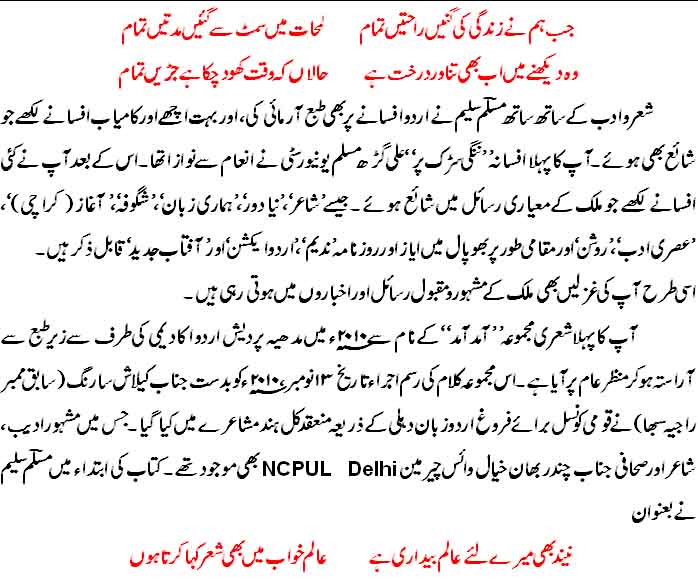
جب ہم نے زندگی کی گنِیں راحتیں تمام

لمحات میں سِمٹ سی گئیں مُدتیں تمام

o

اِک ذرا جب ہم اُٹھا کر سَر چلے

ہر طرف سے دیر تک پتھّر چلے

o

آج پستی بلندی پہ مسلِم

کیسے ہنس کر کھڑی ہو گئ ہے

o

تمام آرزویئں دوزخوں کی نذر ہو گیئں

تمام عُمر جنّتوں کی راہ ڈھونڈتا رہا

o

مُردہ ضمیر زندہ ہیں مصنوی سانس پر

لا شیں سی چل رہی ہیں میرے دایئں بایئں سب

اب کچھ بھی فرق مغرِب و مشرِق میں نہیں رہا

زہر یلی ہو چُکی ہیں جہاں کی ہوایئں سب

Muslim Saleem gave wonderful dimension of thoughts to Urdu ghazal. His couplets can be said" gagar meN sagar".The deeper and larger thoughts in just two poetic lines.Muslim Saleem's "Amad Amad" is a great contribution to Urdu poetry for many reasons: its higher aesthetic seriousness, its artistic intensity its remarkable sensibility, its love for life, its form and content, its subject matter and style.

Muslim Saleem is a journalist of the highest caliber,_honest, reliable, strong and firm. He has worked with the daily Aftab-e-Jadeed (Urdu Newspaper) Danik Bhaskar (Hindi Newspaper) and The English dailies Central Chronicle and National Mail. He is now working with the English daily Hindustan Times Bhopal. His wonderful Website and related blogs reflect his immense excellence and competence. His eight comprehensive Directories of urdu poets and writers are his great Karnamas for the benefit of Urdu lovers and readers of entire urdu world. It is so great, so fantastic, so comprehensive, so remarkable that no one can deny its greatness and utility. Due to his amazing efforts many literary personalities, many important issues, many great things came into light.

Muslim Saleem is a very good story writer. His short stories "NaNgi Sarhak Par" and "Itwar ki Maut" are remarkable for their themes and characters. Muslim Saleem is a polyglot, having good command over five languages -- Urdu, Arabic, Persian, English and Hindi.

Success is achieved through vision, inspiration, resilient determination, diligence, perseverance and hardwork. We hope this special ackno--wledgement and accomplishment will raise his spirit, carry his dream and bring him the pleasure and pride he deserves. This is just the begining of the wonderful things and good luck we hope for him. Allah (SWT) has more and more success and honor planned for him in the future. Amin. He has been working hard and accomplishing great things. His attractive attempt is novel in look and noble in spirit. I hope, wish and believe in it that his great and remarkable Directories and wonderful Website will receive wide appreciation and true realization from all around the World.

May Allah (SWT) bless him and his family. May his path be obstacle-free. Amin.

Dr. Syeda Imrana Nashtar Khairabadi

Atlanta Georgia. USA.

Saturday, March 19, 2011

Muslim Saleem special issue of Adabi Kiran periodical released


(From Left) Ataullah Faizan, Prof Afaq Ahmad, Mr. Laxmikant Sharma, Muslim Saleem and Yunus Makhmoor on the occasion of release of Adabi Kiran’s Muslim Saleem special issue.
Bhopal: March 18, 2011 (Abdul Ahad Farhan): Madhya Pradesh Culture and Public Relations Minister Mr Laxmikant Sharma released a special issue of Urdu periodical Adabi Kiran on noted Urdu poet and writer Muslim Saleem at his residence here. Those present on the occasion included famous Urdu critic Prof Afaq Ahmad, Muslim Saleem, Adabi Kiran’s editor Yunus Makhmoor and khojkhabarnews.com’s editor Ataullah Faizan. Speaking on the occasion, Mr Laxmikant Sharma said that Mr Muslim Saleem, who is a veteran journalist of English, Hindi and Urdu, has been penning poetry for the last 40 years. The collection of his poetry – Amad Amad – has been published recently. Mr Muslim Saleem’s ghazals are on offbeat subjects and he has made many a experiment in ghazal and has assimilated various new issues in his poetry.
In his address, Prof Afaq Ahmad said that Muslim Saleem’s poetry comes from the core of his heart and is connected to ground realities. He has added new dimensions to ghazal and has made the scope of this form of Urdu poetry, in which a poet has to say all in just two couplets. It is to the credit of Muslim Saleem that he has compacted larger thoughts in this cramped space.
Magazine’s editor Yunus Makhmoor said that through the special issue on Muslim Saleem, he has paid tributes to a sincere man and poet. Khojkhabarnews.com’s editor Ataullah Faizan said that he had launched this and other websites to highlight the poetry of his father –Muslim Saleem and these websites have evoked encouraging response.
At the conclusion, Yunus Makhmoor and Muslim Saleem expressed gratitude towards the Culture Minister for sparing precious time for the magazine’s release despite his very tight schedule in view of ongoing session of Madhya Pradesh Assembly.

****************************************************************